

Costs and pricing
Part of Customer data platform costs: a whole-life budget template with a worked £82,500 example
What one customer data journey really costs once buyer-owned work is counted
Compose the full economic cost of one England CDP journey with verified quotation fields, blank formulas, evidence owners and lifecycle assumptions.
The cost of a customer data journey is the full economic cost of one defined route, not the number on a software page. For an England membership service joining authorised account, billing and support events, the budget must cover data work, operation, assurance and exit as well as supplier cash.
Typical year-one totals for that journey run from £120,000 to £425,000. Supplier-specific cells stay blank until the buyer holds an exact, current quotation. Research for this article ended on 6 September 2026, and it is not tax, accounting or procurement advice.
What to take away
- The cost of a customer data platform is the full economic cost of one defined journey, not a software page figure.
- Year one for a mid-market England build typically lands between £120,000 and £425,000; three years between £240,000 and £900,000.
- Buyer-owned work such as discovery, mapping, cleaning, integration and testing must be costed as line items, typically £45,000 to £150,000.
- Every populated cost cell needs an evidence ID, owner, date and confidence note to stay auditable.
- Missing supplier prices stay blank until the buyer obtains an exact, current quotation.
- VAT treatment must be decided by a named UK accountant or tax adviser, not assumed. UK VAT at the standard rate is 20%.
Pin down the purchased work
List the functions separately and mark each as already funded, newly purchased or excluded:
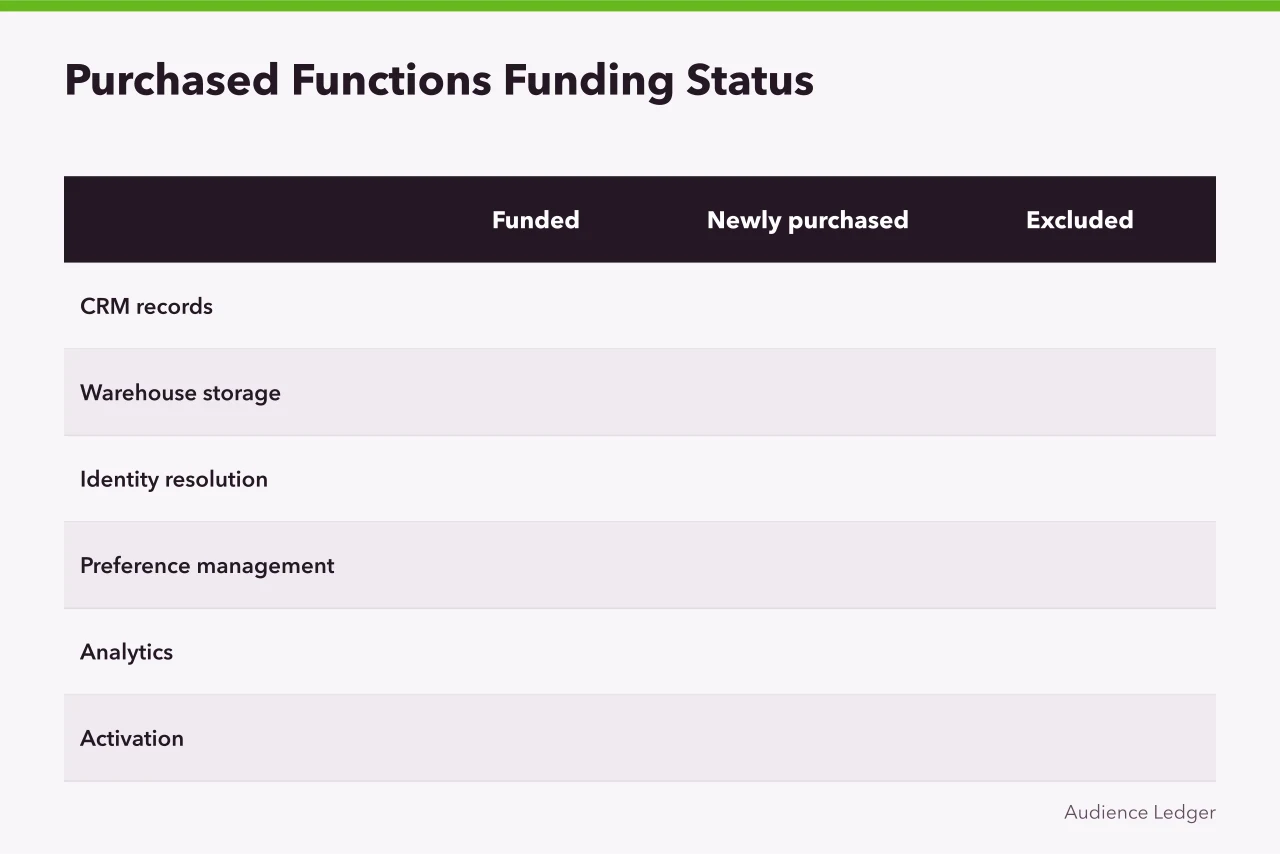
Purchased work is rarely one line. A mid-market England CDP licence typically costs £18,000 to £120,000 a year, driven by monthly tracked profiles and edition. Identity resolution add-ons typically run £12,000 to £45,000 a year.
Implementation partners typically quote £35,000 to £90,000 for a fixed-scope build. Managed connectors and destination maintenance typically add £6,000 to £25,000 a year. Twilio Segment publishes a free tier and paid entry tiers from around $120 a month, with business tiers around $1,200 a month as of 2026.
Enterprise platforms such as Adobe Real-Time CDP, Salesforce Data Cloud, Tealium and Treasure Data price by annual quote. In most markets, enterprise editions start around £60,000 a year and pass £250,000 at high profile volumes.
Usage-based platforms bill in units. Snowflake publishes around $2 per credit on Standard and $3 on Enterprise, roughly £1.60 and £2.40, with storage near $23 per TB each month. BigQuery charges about $6.25 per TiB queried on demand.
Then identify the journey outputs. In this case they are a documented identity decision, preserved correction and suppression states, and an approved audience export. A product category or dashboard does not show that these outputs are supported.
Capture a usable quotation
For each charge, record:
Quotation Fields to Capture
- Supplier legal entity, service, exact edition
- UK availability source and access date
- Currency and VAT treatment
- Unit, quantity, billing period, minimum term
- Included use, mandatory additions, overage rule
- Renewal basis, support boundary, change terms
- Migration, export, deletion, transition charges
Do not combine profiles, events, storage, destinations or seats. Keep service hours separate as well. If a supplier counts merged and unmerged profiles differently, preserve that definition. An absent unit makes the figure unusable for comparison.
Add buyer-owned work
Buyer-Owned Work Line Items
- Discovery and source authority
- Field mapping and data cleaning
- Join-rule design and integration
- Testing and migration
- Privacy and PECR analysis
- Security configuration and log monitoring
- Training, corrections, rights handling, exit
Add privacy and PECR analysis, contract review, security configuration and log monitoring. Then cost incident exercises, accessibility testing, user training, corrections and rights handling. Add change control and renewal. Finish with export, restore, access removal and deletion evidence.
Buyer-owned work is the largest hidden line. UK day rates as of 2026 typically sit at £450 to £700 for a data engineer, £600 to £950 for a CDP or analytics consultant, and £400 to £700 for a privacy specialist.
A mid-market build records 90 to 200 buyer days across discovery, field mapping, cleaning, integration and testing. At a loaded £500 to £750 a day, that is £45,000 to £150,000 before operation, assurance and exit.
ICO data protection by design guidance describes privacy consideration at design and across the lifecycle. It supports budgeting that work early, but does not prescribe its price or approve the buyer's arrangement.
For security, the NCSC's SaaS guidance covers onboarding, privileged access, service identities and monitoring. It also covers incident response and recovery. Cost the buyer's actual controls and evidence collection; do not invent a standard headcount or duration.
Calculate without made-up values
Use blank variables:
Supplier cash = fixed verified charges + sum(unit price x approved quantity x periods) + verified overages
Buyer economic cost = sum(approved loaded labour rate x recorded hours) + direct internal resources
Whole-life journey cost = supplier cash + buyer economic cost + assurance + operation + change + renewal + exit
Every populated cell needs an evidence ID, owner, date and confidence note. A low, base and high case should change declared buyer inputs, not imply statistical probabilities.
A worked example for one England membership service:
- Supplier cash
- £18,000 to £120,000 licence, £35,000 to £90,000 implementation, £6,000 to £25,000 connectors. Subtotal £60,000 to £235,000 with light usage.
- Buyer economic cost
- 90 to 200 days at £500 to £750. Subtotal £45,000 to £150,000.
- Operation, assurance and change
- £15,000 to £40,000 a year for monitoring, accessibility testing, training and corrections.
- Exit and deletion
- 10 to 25 buyer days, plus supplier transition charges of £0 to £20,000.
- Year one total
- typically £120,000 to £425,000. Three-year total: typically £240,000 to £900,000.
Keep the source version with the value. If a quotation expires, usage definition changes or an extra destination enters scope, preserve the former record and open a new budget version. That history lets reviewers explain the movement instead of treating two unlike estimates as a variance in price alone.
Review VAT and release
HMRC says VAT recovery on business expenses depends on circumstances including registration, business use and records. Keep gross cash, VAT and net accounting treatment separate. A named UK accountant or tax adviser must decide the actual treatment and timing.
UK VAT on most CDP contracts is charged at the standard rate of 20%. Some suppliers quote excluding VAT, others include it, so the quotation must say which.
Approve the budget only when the journey, quote and operating assumptions share the same version. Missing supplier prices remain blank. If a source, destination, billing unit, contract or retention requirement changes, reforecast before further commitment.
Before you act
- List each purchased function and state whether it is funded, new or excluded.
- Record supplier entity, edition and currency. Note the unit, quantity, term and overage rule.
- Add buyer-owned line items for discovery, mapping, cleaning, integration and testing, at £500 to £750 a loaded day.
- Give every populated cell an evidence ID, owner, date and confidence note.
- Keep gross cash, VAT and net accounting treatment separate; UK standard rate VAT is 20%.
- Reapprove the budget only when journey, quote and assumptions share one version.
Common questions
What should the budget cover beyond supplier cash?
The budget must cover data work, operation, assurance and exit as well as supplier cash. Buyer-owned work includes discovery, field mapping, data cleaning, integration and testing.
It also covers privacy analysis, contract review, security configuration and log monitoring. Training, corrections, rights handling, change control and renewal are costed too. Expect £45,000 to £150,000 of buyer work on a mid-market build.
Why are supplier cells still blank when typical ranges appear?
No admissible supplier price was identified for the article, and research ended on 6 September 2026. Supplier-specific monetary cells stay blank until the buyer obtains an exact, current quotation. Published and typical ranges are labelled as such, and the article is not tax, accounting or procurement advice, so no supplier figure should be invented.
How should a buyer handle a quotation that expires or changes?
Keep the source version with the value. If a quotation expires, a usage definition changes or an extra destination enters scope, preserve the former record and open a new budget version. That history lets reviewers explain the movement instead of treating two unlike estimates as a variance in price alone.